Stock exchanges
BSE, NSE, MCX and NCDEX: the hours each one trades, what an exchange is, how price discovery works, and how the equity day actually runs, from the opening auction to settlement.
Stock exchanges coming soon. Follow us on YouTube in the meantime.
Markets do not trade in the open. They operate inside exchanges: regulated venues that match buyers with sellers anonymously, apply rules, and guarantee that both sides of a trade perform.
There are stock exchanges all over the world, from the NYSE and the NASDAQ in the United States to London, Tokyo, Hong Kong and Singapore. In India, four exchanges carry the overwhelming majority of activity in the segments this course covers, and each one specialises in a segment.
The four exchanges
| Exchange | Segment | Trading hours (IST) |
|---|---|---|
| BSE (Bombay Stock Exchange) | Equities and derivatives | Cash 9:15 AM – 3:30 PM, then its own closing and post-close windows running to 4:00 PM |
| NSE (National Stock Exchange) | Equities and derivatives | Cash 9:15 AM – 3:30 PM, derivatives to 3:40 PM, post-close 3:50 – 4:00 PM |
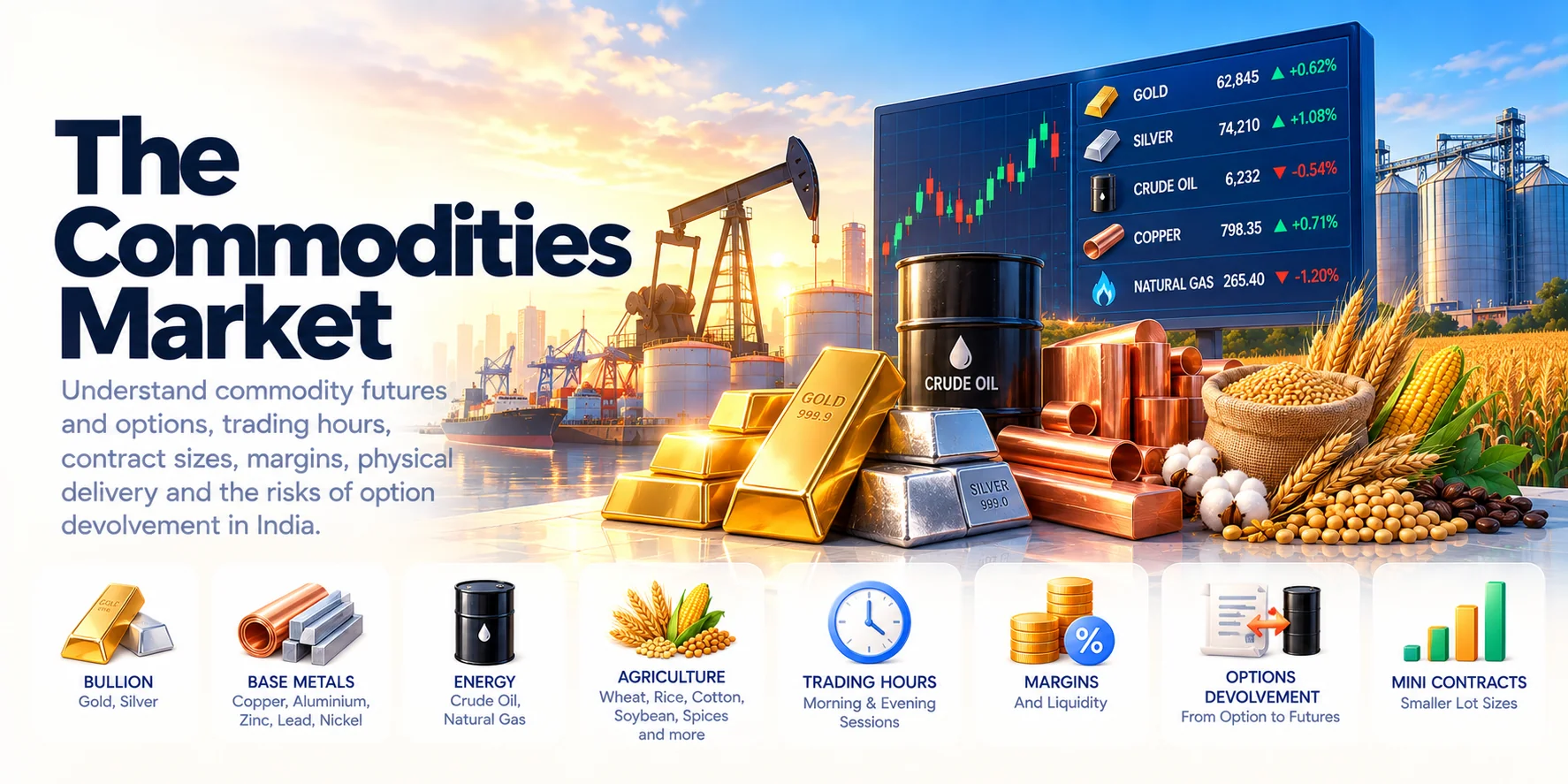
| MCX (Multi Commodity Exchange) | Commodity derivatives | Non-agri 9:00 AM – 11:30 PM or 11:55 PM; agri linked to world markets to 9:00 PM; other agri to 5:00 PM |
| NCDEX | Agricultural commodity derivatives | Pre-open 9:45 – 10:00 AM, then 10:00 AM – 5:00 PM; the rainfall contracts are the only ones trading later, to 11:30 PM or 11:55 PM |
BSE and NSE hold the equity and equity-derivatives markets. MCX and NCDEX hold commodity derivatives. India has other recognised exchanges and segments, but they carry a small share of retail activity, and the four above are what a new investor will meet.
Exchange rankings move, so treat any “largest” claim as dated. NSE is currently the largest derivatives exchange in the world measured by contracts traded, and BSE, founded in 1857, is Asia’s oldest. Both describe a particular measure on a particular date rather than a permanent fact.
Forex derivatives trade on the NSE currency segment. CCIL is not a trading venue. It is a clearing corporation providing clearing and settlement services for specified markets, which is a different job from matching buyers and sellers.
MCX’s closing times are not one number. It groups contracts into three categories, and they close at three different times. The split follows how closely each contract tracks an international price.
Exchange timings change through circulars, not through this page. Everything above was last verified on 13 October 2026 against NSE circular NSE/CMTR/74466 and its successors, MCX’s published trading-session schedule, and NCDEX circulars NCDEX/TRADING-021/2026 and NCDEX/TRADING-044/2026. If a time here disagrees with your terminal, the exchange circular wins.
The commodity hours are not the equity hours, and they are not even the same shape. MCX runs a morning session and then an evening session that reaches nearly midnight, because its contracts follow international price moves rather than the Indian working day. NCDEX is a daytime exchange: every general and agricultural contract on it closes at 5:00 PM, and the only exception is the handful of rainfall contracts described below.
MCX changes its closing time twice a year, and it is the detail most likely to catch a retail trader out. Bullion, crude oil and gas trade until 11:30 PM while the United States is on daylight saving, and until 11:55 PM when it is not. The same gold contract therefore has two different closing times in the same year, and the switch follows the US clock rather than the Indian one. Check the current exchange circular before planning anything around an evening commodity position.
NCDEX runs a pre-open session of its own, from 9:45 AM to 10:00 AM, a quarter of an hour later than NSE and BSE. It also allows client code modification until 5:15 PM, half an hour after the normal session ends, which is the window in which your trading terminal lets you change the client code on an intraday position. Intraday commodity positions are squared off at 4:50 PM.
The rainfall contracts are NCDEX’s one long-running exception. The Mumbai (RAINMUMBAI) and Chennai (RAINCHNNAI) contracts trade 10:00 AM into the night through the monsoon months, June to September for Mumbai and September to December for Chennai, tracking rainfall against a settled figure. Their standard close is 11:30 PM, or 11:45 PM depending on the rules of the particular monsoon contract. Between 2 November 2026 and 12 March 2027 the winter schedule applies and they extend to 11:55 PM, under circular NCDEX/TRADING-044/2026. That adjustment follows the same daylight saving logic as MCX, but on NCDEX it touches only these weather contracts: everything else on the board has gone dark at 5:00 PM.
MCX’s internationally linked agricultural contracts close at 9:00 PM, well before the bullion and energy contracts that follow them through the US session.
On many festival days MCX is only half shut. It declares the morning and evening sessions separately, so a morning holiday still opens the evening session at 5:00 PM. “The commodity market is closed” is often not the whole of it. NCDEX and the equity exchanges run a single continuous day and close entirely.
The equity hours are set out in full below.
How price discovery actually works
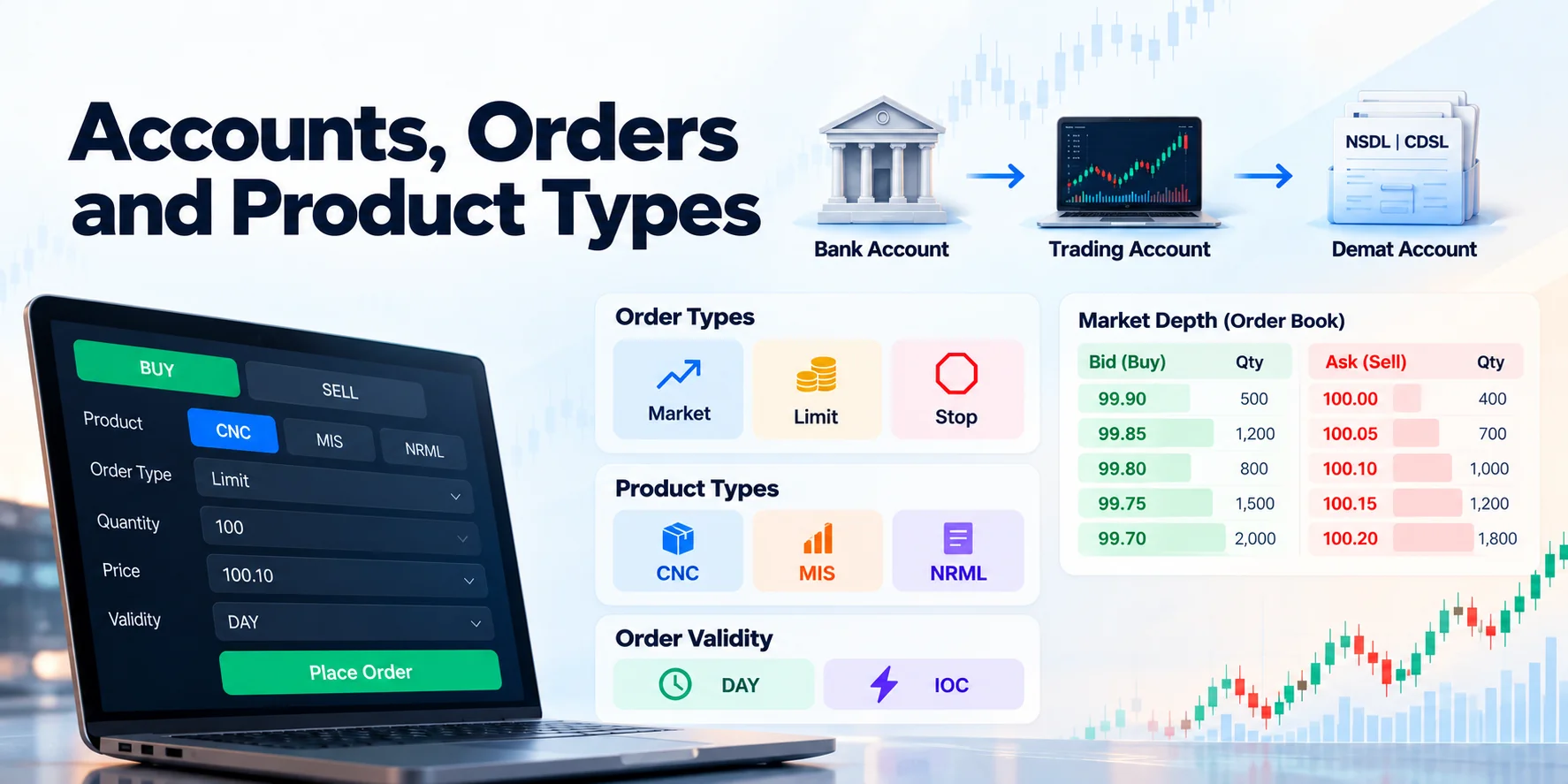
There is no single seller setting a price. The exchange maintains an order book: a live queue of pending buy and sell orders at each price level, which your broker shows as market depth.
When a market order hits the book, it executes against whatever is available at the best price, then the next, and so on. That is why a large order moves the price: it consumes the best offers and reaches further into the book. A market order is an instruction to trade at the best available price, not a guarantee of a fill, so in a thin scrip part of it may go unexecuted or slip to a worse level.
Matching follows price-time priority: the best price first, and at that price whoever arrived first.
The closing price is not the last traded price, nor a simple average. Since 3 August 2026, eligible stocks set it through a closing auction that gathers orders at the end of the day and clears at a single price. How that works is covered under the closing price.
Indices
An index is a number that measures a basket of shares. It is calculated, not traded.
- NIFTY 50: 50 large-cap companies on the NSE.
- SENSEX: 30 companies on the BSE (Bombay Sensex).
- BANK NIFTY: the banking sector only.
An index is useful as a benchmark: to measure whether your portfolio beat the market, or to build an index product around.
How the equity trading day runs
Everything below is the equity cash and equity derivatives segments on BSE and NSE: when they trade, how the official close is set, when money and shares actually move, and what backs a leveraged position.
The equity-market schedule from 3 August 2026
Since the closing auction went live on 3 August 2026, there are two equity schedules rather than one. Stocks with active futures and options contracts clear through an auction; everything else keeps the old volume-weighted close.
| Session | Stocks with active F&O contracts | All other listed stocks |
|---|---|---|
| Pre-open | 9:00 – 9:15 AM | 9:00 – 9:15 AM |
| Continuous trading | 9:15 AM – 3:15 PM | 9:15 AM – 3:30 PM |
| Closing | Closing auction, 3:15 – 3:35 PM | No auction; VWAP of 3:00 – 3:30 PM |
| Derivatives (all stocks) | to 3:40 PM | to 3:40 PM |
| Post-close | 3:50 – 4:00 PM | 3:50 – 4:00 PM |
The auction window itself closes for order entry at a random time between 3:28 PM and 3:30 PM, which discourages last-second order flooding. BSE runs the same broad structure under its own closing and post-closing framework, so its times can differ by a few minutes.
So a single answer of “the market closes at 3:30” is wrong at the level of an individual stock. Which schedule your stock follows is worth knowing before you plan around the close.
Pre-market sessions
The pre-market session in Indian equity markets runs from 9:00 AM to 9:15 AM and is called the pre-open session. It is not a continuous trading session: during this time, orders are collected and matched through a call auction to discover the opening price. No trades are executed during the order collection window in the sense of continuous matching, and only the final opening price trades at 9:15 AM when the market moves into continuous trading. This helps absorb overnight news and prevents wild price jumps at the open.
The closing price is an auction, not a VWAP
Earlier, the official close was calculated as a volume-weighted average (VWAP) of trades between 3:00 PM and 3:15 PM. Now, the Closing Auction Session (CAS) does something better: it pools all eligible buy and sell orders (limit and market orders) in the auction and finds a single equilibrium price: the price at which the maximum number of shares can trade. That equilibrium price is the official closing price.
How CAS works
- Reference price is set (3:00 – 3:15): calculated from VWAP of trades between 3:00 PM and 3:15 PM. If there were no trades in that window, it falls back to the last traded price, or the previous day’s close if the stock didn’t trade all day. A ±3% price band is applied around that reference price for CAS orders.
- Auction order collection (3:15 – 3:28/3:30): you can place, modify and cancel limit and market orders during 3:15 – 3:25 PM. From 3:25 PM to the random close, only limit orders can be placed, modified or cancelled; market orders cannot be changed or added. The order entry window closes at a random time between 3:28 PM and 3:30 PM, never at a fixed second.
- Matching (immediately after random close): once the window closes, the exchange matches all orders at the equilibrium price. Market orders are matched first, then the rest by price-time priority (best price, and at that price the order that came first). All matched trades execute at the same single equilibrium price.
- Close and post-close: that equilibrium price becomes the official closing price. It is published around 3:35 PM and is what index values, NAVs, margin marks and F&O settlements use. A post-close window from 3:50 PM to 4:00 PM lets trades happen at that fixed closing price. For equity derivatives, trading continues until 3:40 PM on the same close.
Determining the equilibrium price
The exchange checks every feasible price level to see how many shares can be executed (the smaller of cumulative buy vs cumulative sell quantity at that level), choosing the price that gives maximum executable volume. If two prices produce the same maximum executable volume, it picks the price with the smaller imbalance between buy and sell. If still tied, it goes with the price closest to the reference price. If the reference price sits exactly midway between two candidates, the reference price itself becomes the close. If no shares can match at all, the reference price becomes the official closing price and no auction trades execute.
This is the part worth being precise about. A closing auction aggregates eligible buy and sell orders and determines a single equilibrium price. It can improve the price discovery at the close, because it lets demand and supply that never met during the day meet each other at one price. But it does not guarantee a fair price. The result still depends on which orders arrived, how much liquidity there was, and how those orders were placed. An auction is a better mechanism, not an immune one.
The old close versus the auction
Three different numbers get confused here, and keeping them apart is the whole point.
- The old closing price was the volume-weighted average of every trade in the final 30 minutes of continuous trading, normally 3:00 – 3:30 PM.
- The reference price for the new auction is a volume-weighted average too, but of a shorter window, 3:00 – 3:15 PM. It is an input to the auction, not its result.
- The closing price under the auction is neither of those. It is the equilibrium price the auction produces.
| Aspect | Old close (VWAP, 3:00 – 3:30 PM) | Closing auction |
|---|---|---|
| Basis | Average of executed trades over a time window, weighted by volume | Auction-cleared price: one price that maximises executable volume |
| What counts | Only executed trades in that window | All pending orders placed in the auction, including latent demand and supply |
| Sensitivity | Can be moved by a single large trade near the end | An order joins the pool rather than setting the result on its own |
| Result | VWAP, a blended price | Equilibrium price, a single market-clearing price |
| Purpose | Meant to smooth late trading | Designed to improve the price discovery at the close |
Settlement: T+1 and T+0
Settlement is when money and shares actually change hands. Indian equity trades generally follow a rolling T+1 cycle: a trade done on day T settles on the next working day, through the clearing corporation and the depositories.
Trading and settlement are separate things, and this is where most beginners get confused. Whether you are allowed to sell a share again the same day you bought it depends on the security, the trading facility, your broker and the applicable rules. It does not mean the sale settled the same day. Intraday trading arrangements let you buy and sell the same scrip within a day; the delivery obligation behind it still follows its own cycle.
- T+1 is the standard cycle for eligible equity trades.
- T+0 is an optional same-day settlement facility, available for eligible securities and participants under exchange rules rather than to everyone by default.
- Short delivery: if securities are not delivered as required, the clearing corporation may conduct a buy-in auction or apply the relevant close-out mechanism, depending on the settlement category. A normal short-delivery auction settles on a later day than the standard cycle.
Check the current exchange settlement calendar and your broker’s terms before relying on any particular timeline.
Margins
A margin is collateral held against a position. It is not a fee, and it is not a cap on your losses.
- Equity delivery: buying shares generally requires funds to cover the purchase, subject to your broker’s policies and any permitted funding facility.
- Intraday and leveraged positions: the requirement depends on the product, the broker, exchange rules and current risk controls. Leverage magnifies gains and losses equally.
- Futures and options: margin varies by contract and position. It commonly includes an initial or SPAN component, an exposure component and an extreme-loss margin, and it rises when volatility rises or when the exchange widens the applicable limits.
Treat any specific margin percentage you read, including a figure in an old article, as an illustration rather than a rule. Index futures margins quoted at around 12% are a common example of a typical figure, not a universal one: the actual requirement is set per contract and moves with the market.
If the margin falls short of what the broker requires, the position may be liquidated, and losses can exceed the collateral originally posted.
F&O settlement
- Stock futures settle by physical delivery, so the buyer takes delivery of the shares.
- Index futures settle in cash, because nobody can deliver the index itself.
- Options do not normally create a delivery obligation. The buyer of a call who exercises it acquires a delivery obligation at expiry, while the writer is obliged to deliver. Whether that obligation crystallises depends entirely on whether the option finishes in the money.
There is also a distinction between the daily settlement a contract goes through on each trading day, marking it to market, and final settlement on expiry day, which produces the actual delivery or cash payment.
Next: equity basics.