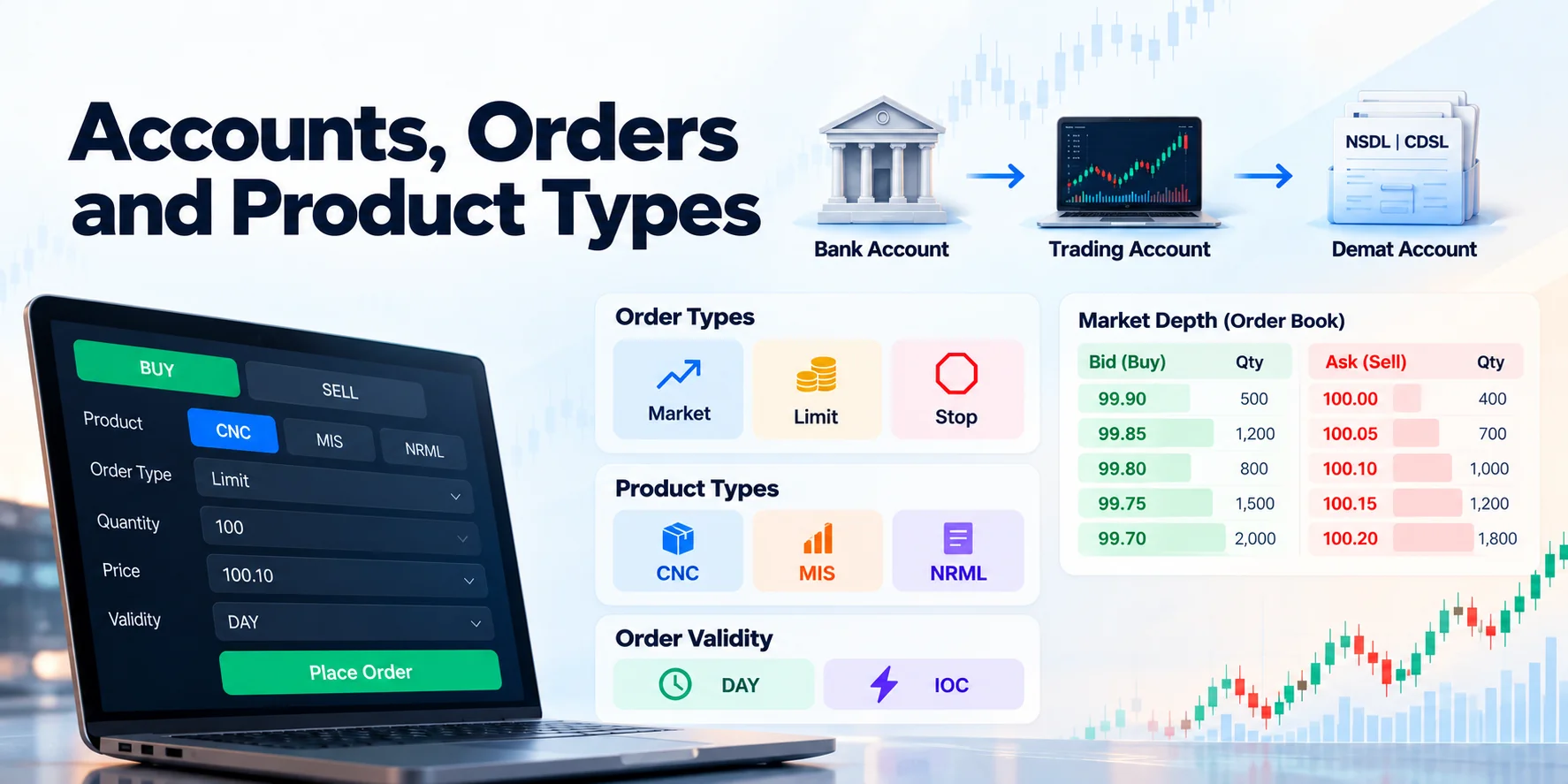
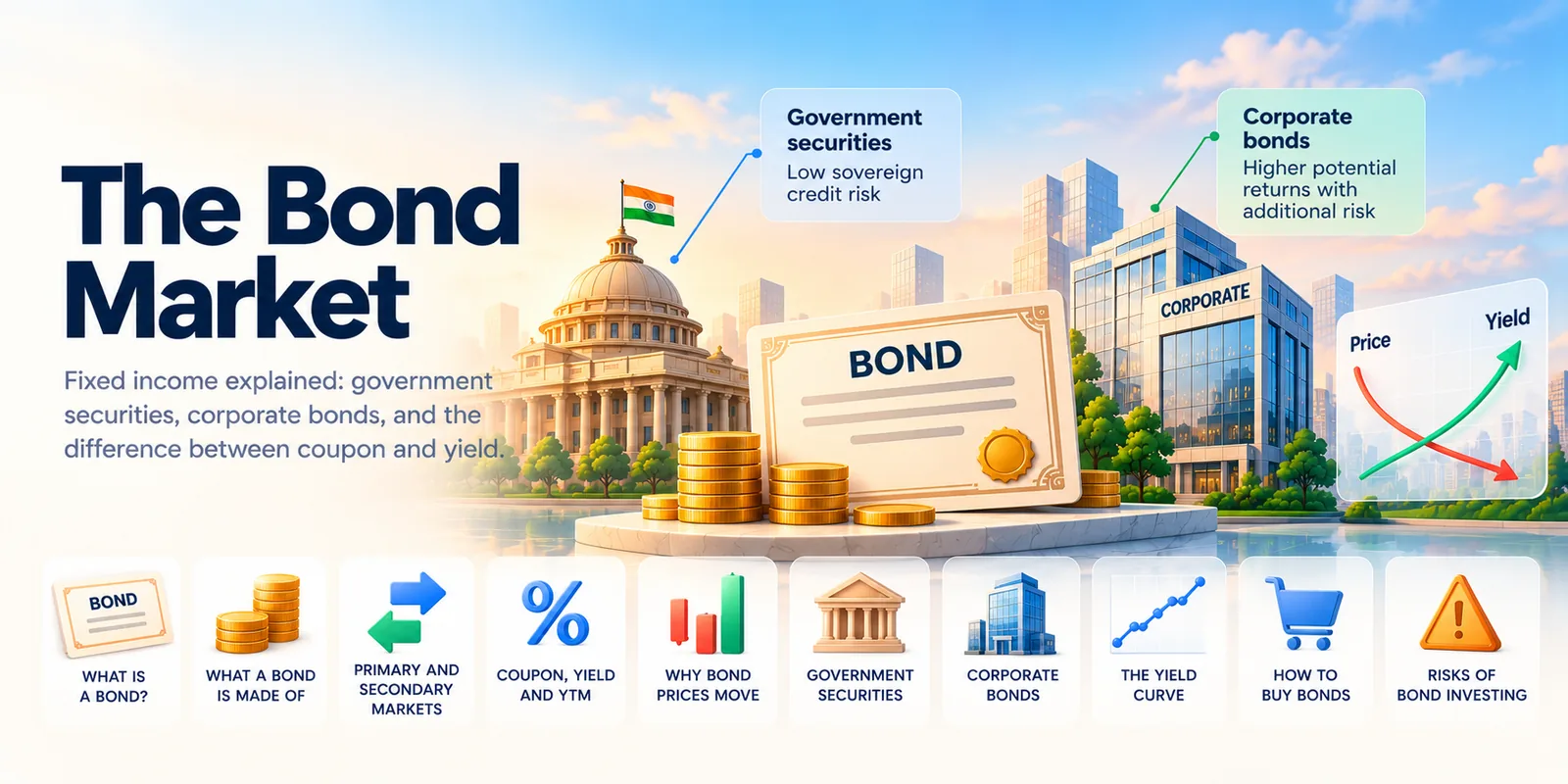
The Share Market
What a share is, primary and secondary markets, face, book and market value, market capitalisation, and how dividends, bonus issues, splits and rights issues work.
The Share Market coming soon. Follow us on YouTube in the meantime.
A share (or equity unit) is one unit of ownership in a company. If a company has 1,000 equity shares outstanding with equal ownership rights and you own one of them, you hold 0.1% of its equity.
Shareholders may receive dividends and may gain if the share price rises, but neither is guaranteed. What a shareholder is entitled to depends on the class of share, the company’s governing documents and applicable law.
Equity shareholders have a residual claim: if the company is wound up, they are paid what is left after creditors and other higher-ranking claims have been settled. That is the other side of the return, and an equity investment can lose some or all of the capital invested.
Primary and secondary markets
Two different markets do two different jobs, and keeping them apart is one of the most useful things a beginner can pin down.
The primary market is where securities are issued to investors. A company raises capital by issuing new shares, which may be through an initial public offering (IPO), a further public offering or a rights issue.
An issue has two possible parts, and they pay different people:
- Fresh issue: the company issues new shares and receives the proceeds.
- Offer for sale (OFS): existing shareholders sell their shares, and the proceeds go to those shareholders rather than to the company.
The secondary market is where investors buy and sell existing securities, typically through a stock exchange such as NSE or BSE. When you buy shares of a listed company through your broker on the NSE, the transaction generally involves buying existing shares from another market participant. The seller receives the sale proceeds, subject to the applicable charges and settlement arrangements.
Secondary-market trading gives you liquidity, and it is where the price moves in response to buying and selling activity, company performance, expectations and broader market conditions.
| Primary market | Secondary market | |
|---|---|---|
| Purpose | Issue securities to investors; a fresh issue raises capital for the company | Let investors trade existing securities |
| Who receives the proceeds | The company in a fresh issue; the selling shareholders in an OFS | The investor selling the securities |
| Example | Subscribing to the fresh-issue portion of an IPO | Buying listed shares through NSE or BSE |
| How the price is set | The applicable issue-pricing process, such as book building or a fixed-price offer | The exchange’s trading mechanism, against available orders, supply and demand |
A company does not receive money every time its shares are traded on the stock exchange. It receives capital when it raises funds through an issue of securities. Secondary-market transactions generally transfer money between investors.
Two words you will meet constantly:
- Stock exchange: a regulated marketplace where eligible securities are traded under applicable exchange rules.
- Broker: an intermediary through which investors place orders to buy or sell securities on an exchange.
Three values, and why the difference matters
These get confused constantly. Fix them once and half the confusion in the market goes away.
| What it means | What makes it change | |
|---|---|---|
| Face value (FV) | Nominal value assigned to a share by the company | Corporate actions such as a split or consolidation |
| Book value (BV) | The company’s accounting net worth attributable to equity shareholders, divided by the number of equity shares outstanding | Changes in the company’s financial position and share count |
| Market price (MV) | The price at which a share trades in the market | Buying and selling activity, expectations and market conditions |
Face value is not the price you pay. ₹10 is a common face value among Indian companies, but companies can have other face values, and it can change through corporate actions such as a stock split or consolidation.
Book value changes as the company’s assets, liabilities, earnings, losses and share count change. Published financial statements give periodic snapshots of that position. Book value is an accounting measure, and it does not necessarily represent the company’s intrinsic or economic value.
Market price is the price at which a share trades, and the three prices on your screen are not the same number:
- Last traded price: the price of the most recent completed trade.
- Bid price: the price buyers are currently offering.
- Ask price: the price sellers are currently asking.
Say the last trade printed at ₹198.30, the best bid is ₹198.25 and the best ask is ₹198.35. Your next order will fill around those two quotes, not necessarily at the last traded price. What you actually get depends on the orders available, liquidity, your order type and market conditions.
Only the market price tells you what the market currently thinks the claim is worth, which is why every price on your screen is the market price.
Market capitalisation
Market capitalisation = outstanding equity shares × market price per share.
A company with 10 crore outstanding equity shares trading at ₹200 per share has a market capitalisation of ₹2,000 crore.
Market capitalisation measures the market value of a company’s equity. It is not the same as the company’s book value, its cash balance or its enterprise value.
Free-float market capitalisation
Free-float market capitalisation considers the shares available for public investment under the applicable methodology, after specified strategic or non-investible holdings, such as promoter stakes and locked-in shares, are excluded.
It matters in many stock-index methodologies, including free-float-weighted indices such as the Nifty 50. Index providers do not all apply identical inclusion criteria or weighting methods, so read the methodology of the particular index you are looking at.
It is a measure of size, not a measure of how easily you can trade. How easily you can actually buy or sell also depends on:
- trading volume and turnover,
- the bid-ask spread,
- order-book depth,
- market conditions and the size of the order you are placing.
A company can have a high total market capitalisation and a small free float. What tells you more about tradability is the day’s volume and the spread, not the free-float number on its own.
Putting the three together
One fictional company, with all six figures side by side:
| Measure | Figure | What it is |
|---|---|---|
| Equity shares outstanding | 10 crore | How many equal pieces of equity exist |
| Face value per share | ₹10 | The nominal value the company assigned |
| Market price per share | ₹200 | What the market pays for one share today |
| Market capitalisation | ₹2,000 crore | 10 crore × ₹200 |
| Accounting net worth attributable to equity | ₹500 crore | Assets less liabilities, on the books |
| Book value per share | ₹50 | ₹500 crore ÷ 10 crore shares |
The same share carries a face value of ₹10, a book value of ₹50 and a market price of ₹200, and all three are correct at the same moment. Market capitalisation reflects the market’s valuation of the equity; book value reflects what the accounts say the equity is worth. Neither one on its own tells you whether a stock is a good investment.
How returns reach you
Dividends. A distribution of company profits, or other legally distributable funds, to eligible shareholders, subject to applicable law and the approval process the company’s governing documents require. For Indian resident individual investors, dividend income is generally taxable at the applicable income-tax rate as income from other sources, rather than under the capital-gains rules. That is a general description of the treatment, not advice on your position.
When a share goes ex-dividend, its price generally adjusts downward by approximately the dividend amount, all else being equal. The actual price can move differently, because a market prices expectations rather than doing arithmetic.
Bonus shares. A bonus issue gives eligible existing shareholders additional shares without any payment for those shares, through the capitalisation of eligible reserves.
In a 1:1 bonus issue, an investor holding 100 shares receives another 100. The holding becomes 200 shares and the theoretical price per share becomes half the previous price, all else being equal. Nothing was paid out and the same reserves are now divided into more pieces, so the bonus issue itself does not create additional economic value.
Stock splits. A stock split divides existing shares into multiple shares and proportionately reduces the face value per share.
In a 1:5 split, one share with a face value of ₹10 becomes five shares with a face value of ₹2 each. If the pre-split market price is ₹1,000, the theoretical post-split price is ₹200 per share, all else being equal. A split may make the per-share price more accessible and may improve trading liquidity, but neither outcome is guaranteed.
Starting from 100 shares of face value ₹10 each, at a market price of ₹400, worth ₹40,000:
| Bonus issue (1:1) | Stock split (1:5) | |
|---|---|---|
| How the shares arise | New shares created by capitalising eligible reserves | Existing shares divided into smaller units |
| Shares held (from 100) | 200 | 500 |
| Face value per share | ₹10, unchanged | ₹2, reduced in proportion |
| Theoretical price per share | ₹200 | ₹80 |
| Value of the holding | ₹40,000 | ₹40,000 |
| Wealth created | None | None |
Neither a bonus issue nor a split creates wealth by itself. Both change the unit you hold it in, and your actual return depends on what the price does afterwards and on everything else that moves it.
Rights issues. A rights issue offers existing shareholders the opportunity to subscribe to additional shares, generally in proportion to their existing holdings. In a 1:5 rights issue, an eligible shareholder may apply for one additional share for every five held, subject to the offer terms.
A rights issue raises capital for the company. Issues are often priced below the prevailing market price, but the price is set by the offer terms, so read them rather than assuming one. If you do not participate, your percentage ownership of the company falls. Whether unused entitlements can be transferred to someone else depends on the offer terms and the applicable arrangements, so check the offer document.
Buybacks. A buyback occurs when a company repurchases its own shares through a permitted mechanism. If the company reduces its outstanding share count, a shareholder who keeps their shares will generally own a larger percentage of the company.
That is the arithmetic, not a promise. A buyback does not by itself guarantee a higher share price, added value or a better return for shareholders.
IPO
An initial public offering (IPO) is a company’s first public offering of shares to investors. An IPO can contain two components, or just one:
- Fresh issue: the company issues new shares and receives the proceeds, to be used for the purposes described in its offer documents.
- Offer for sale (OFS): existing shareholders sell their shares, and the proceeds go to those selling shareholders.
An IPO can give a company access to public capital markets and a publicly traded share price, which is also what makes ESOPs and later fundraising possible. It is a step, not a finish.
The IPO issue price is not a guarantee of intrinsic value, and the price after listing depends on demand, supply, valuation, the company’s prospects and broader market conditions. Price discovery in a new issue is imperfect, so prices in the first weeks after listing can be far from any valuation you could defend. That cuts both ways: it is not a reason to assume every IPO is mispriced either.
What helps is reading the business, the financial position, the valuation in the offer document and the risks, rather than listing-day excitement.
Next: the bond market.