Market participants
The three intentions behind every order (investing, trading and hedging), who carries each one, and the machinery that settles what they trade.
Every trade has two sides, and behind them a small cast of characters. Knowing who else is in the market, and what they are trying to do, is most of what explains why prices behave the way they do.
Three kinds of participant
The same three intentions appear in every market, whatever is being traded.
- Investors: buy and hold for the long term, looking for a business that compounds or income that pays.
- Traders: buy and sell at short intervals, from minutes to days.
- Hedgers: trade specifically to reduce or offset risk, usually protecting an existing position rather than earning from the trade.
These are intentions, not job titles. The same person can be all three in the same account: holding a stock for a decade, trading futures this week, and hedging a currency exposure they carry in a business.
Who is in each group
An intention is abstract; the people carrying it out are not. Each group is wider than it first looks, and each does something for the market that goes beyond its own profit.
Investors: the ones who provide capital
Start with individuals: a young professional setting up a monthly SIP on a phone, a family steadily building a retirement corpus. Then add the institutions doing the same job for thousands of people at once: mutual funds pooling savings, pension funds, and insurance companies investing the premiums they hold.
Their long-term money becomes capital. When a company raises fresh funds through an IPO or a bond, that money pays for expansion, new technology and hiring. When the government issues securities, the same appetite funds highways, metro rail, bridges, airports, hospitals, renewable energy and digital infrastructure.
Most buying and selling happens after that, in the secondary market, where no cash reaches the company. It still matters, because it is the exit that makes anyone willing to fund the business in the first place: capital goes where the investor knows they can get it back.
Traders: the ones who provide liquidity
Traders are the opposite temperament: retail traders, professional traders, algorithmic systems, and market makers whose entire job is to quote a buying and a selling price all day. They trade frequently, aiming to profit from short-term moves rather than from the business itself.
What they give everyone else is liquidity: the ability to enter or exit a position without moving the price far. And price discovery: the endless argument over what an asset is actually worth, which their constant competition settles a little more each time. The market maker at the centre of that argument is why you can usually sell close to the price you last saw quoted.
Hedgers: the ones who manage risk
Not everyone is here to make money from the market. A farmer hedges the price of a crop long before it is harvested. A jewellery business hedges the gold it will need. An airline hedges fuel, an exporter locks in the rupee value of the dollars it is owed, and a manufacturer hedges the raw materials it buys.
Each of them uses a futures or forward contract to lift a price they cannot control out of a plan they can. A hedger gives up the chance of a windfall in exchange for removing the risk of a disaster, and then gets back to the real business, which was never trading.
That is the cast. What turns their orders into a market is the machinery underneath.
The machinery behind every trade
A trade is really two promises, securities on one side and money on the other, and the market’s plumbing is what makes both sides keep them.
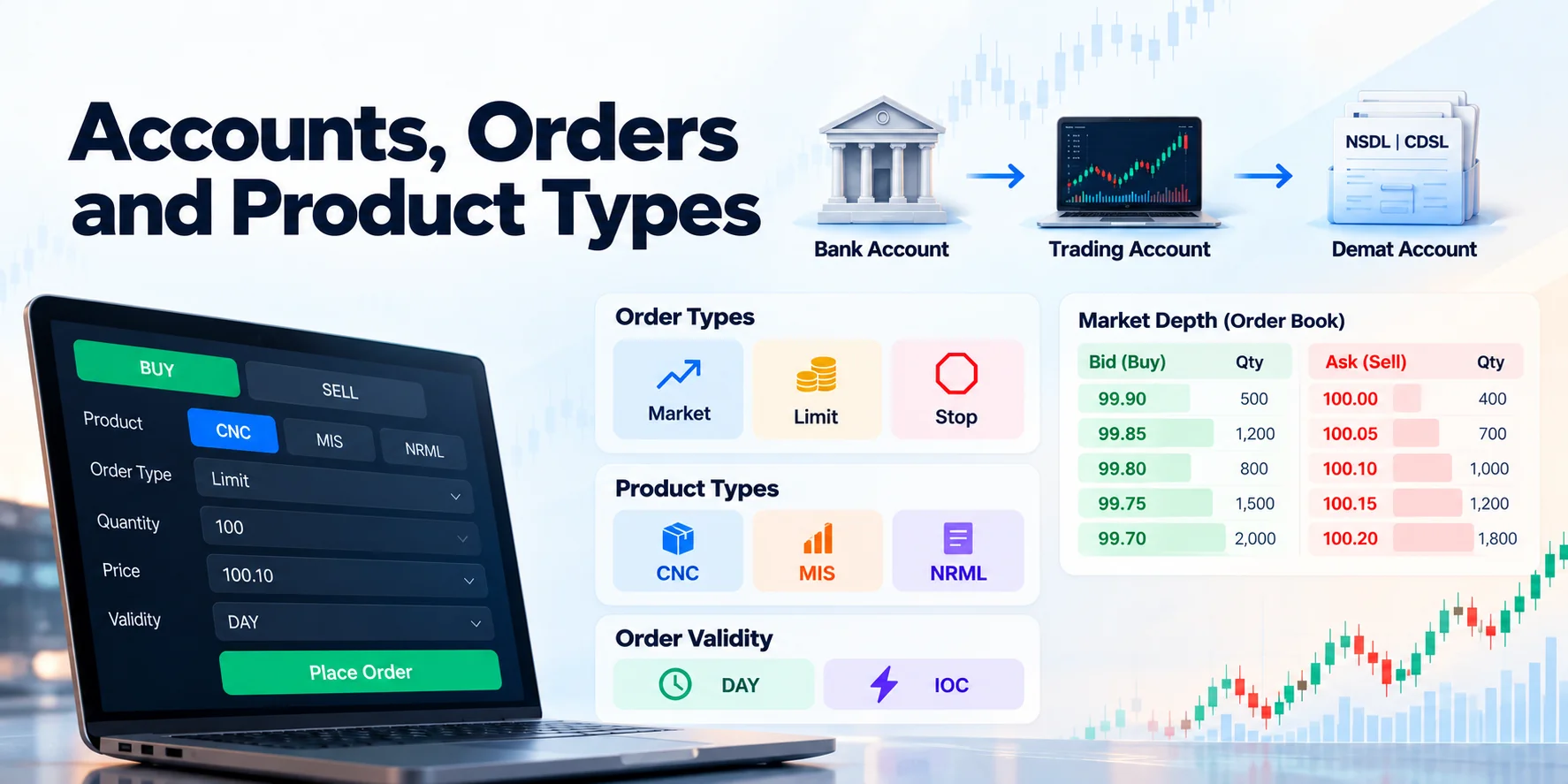
- Broker. Takes your order, checks you have the funds or margin to back it, and routes it to an exchange. It is your only point of contact: you never deal with the rest of the chain directly.
- Stock exchange. The electronic marketplace (NSE, BSE) where your buy is matched against someone else’s sell. Matching is what sets the price, and it is the only part of the process you can watch happen in real time.
- Clearing corporation. Once a trade is matched, the clearing corporation steps between the two sides and becomes the legal counterparty to both, guaranteeing shares to the buyer and money to the seller even if one of them defaults. It is the institution most people have never heard of, and the one that makes a stranger’s promise safe to rely on.
- Depositories. NSDL and CDSL hold shares in electronic form. On settlement they move the securities from the seller’s demat account to the buyer’s. This is the record that ultimately says who owns what.
- Banks. The money leg. Funds flow from the buyer, through the clearing corporation’s settlement account, and out to the seller. Equities in India settle on a T+1 cycle, so the whole thing completes the next working day.
So the broker carries the order, the exchange matches, the clearing corporation guarantees, the depositories transfer the securities and the banks move the cash. That is the ecosystem, and it is why “who is in the market?” has two answers: the participants taking positions, and the machinery that exists so those positions can be trusted.
Next: stock exchanges.