What It Costs
Understand brokerage, STT, CTT, GST, exchange charges, stamp duty, demat fees and the real cost of every trade.
What it costs coming soon. Follow us on YouTube in the meantime.
Most trading losses are not bad ideas. They are good ideas that did not survive the charges. A strategy can be directionally right every time and still lose money if the cost of each round trip is large relative to what it earns.
This chapter is deliberately numerical. It explains what each charge is, and then works examples so you can see the arithmetic rather than approximate it.
This is an educational overview, not financial or tax or legal advice. Charges change with budgets, circulars and broker policies, and they differ by exchange, segment, product and date. Treat every rate here as dated, and verify against your contract note and the current exchange schedule before trading. Tax treatment is in taxation.
Gross is not net
Gross trading P&L is your profit or loss before transaction costs. Net trading P&L is what remains after the applicable charges.
Net trading P&L = Gross trading P&L − Applicable trading charges
The economic return on your money is one step further out again, because financing, margin interest and tax on income or gains also come off. That last one is a different kind of cost entirely: STT, CTT and stamp duty are transaction levies, while income tax on trading profits is an annual liability. Keeping the two apart avoids the commonest confusion in this area.
Costs bite hardest when profits are small or trades are frequent. That is a statement about arithmetic, not a verdict on any particular strategy. A high-turnover approach can be profitable, but only if its edge per trade comfortably exceeds its cost per trade.
What kind of charge is it?
Knowing who sets a charge tells you who can change it, and whether it is negotiable.
| Group | What it includes |
|---|---|
| Broker-controlled fees | Brokerage, platform fees where applicable, DP service charges set by the DP, pledge and unpledge service fees, margin funding interest, other broker service fees |
| Exchange and regulatory charges | Exchange transaction charges, SEBI turnover fees, Investor Protection Fund Trust contributions where applicable, clearing charges passed through under the relevant tariff |
| Government taxes and duties | STT, CTT, GST, securities stamp duty |
Only the first group is negotiable. A government tax is not something a broker can waive.
Brokerage
Brokerage is the broker’s own fee, and there are four common shapes:
- Zero brokerage on eligible products, often equity delivery.
- Flat per executed order, a fixed rupee amount each time an order trades.
- Percentage of turnover.
- Hybrid, a percentage subject to a maximum cap.
Brokerage is charged on executed orders, not submitted orders. The distinction matters because one order can produce several trades, and a partially filled order is not the same as a completed one. Brokers differ in whether they charge per order or per trade, and what a broker bills as an “order” on its contract note is not automatically the same count the exchange displays as trades. Do not equate the exchange’s trade count with the broker’s billed count without checking that broker’s own tariff.
Zero brokerage does not mean zero cost. If brokerage is nil, the other lines on the contract note are still there. The most common surprise for a beginner is a trade that shows no brokerage and still shows STT, stamp duty, exchange charges, SEBI fees and GST.
Exchange transaction charges
Exchanges charge a fee for matching trades, under published segment-specific schedules. The rate depends on the segment and the calculation basis, and it is not one percentage for everything.
The important case is equity options, where the exchange fee is charged on premium turnover rather than on the underlying notional. That is the difference between paying a fee on the option premium and paying a percentage of a much larger index value.
Current NSE rates, revised with effect from 1 March 2026, are:
| Segment | Rate | Basis |
|---|---|---|
| Cash equity | 0.00307% (₹307 per crore) | Turnover |
| Equity futures | 0.00183% (₹183 per crore) | Turnover |
| Equity options | 0.0355299% (₹3,553 per crore) | Premium turnover |
Do not apply these to other exchanges. BSE publishes its own schedule, and its rates differ.
SEBI turnover fees
SEBI charges a fee on securities turnover:
| Nature of securities | Rate | Equivalent |
|---|---|---|
| All sale and purchase transactions in securities other than debt securities | 0.0001% | ₹10 per crore |
| All sale and purchase transactions in debt securities | 0.000025% | ₹2.50 per crore |
The standard rate is therefore 0.0001%, but debt securities carry a different and lower rate. Applying one rate to every category of security is a common simplification that happens to be wrong for bonds.
STT: the rates effective 1 April 2026
Securities Transaction Tax is a statutory tax on the value of a taxable securities transaction. The Finance Act 2026 raised the futures and options rates with effect from 1 April 2026; other STT rates were unchanged.
| Transaction | Rate from 1 Apr 2026 | Charged to, and on what |
|---|---|---|
| Equity delivery purchase | 0.10% | Buyer, on the purchase value |
| Equity delivery sale | 0.10% | Seller, on the sale value |
| Equity intraday, non-delivery sale | 0.025% | Seller, on the sale value |
| Equity-oriented fund unit sale, delivery | 0.001% | Seller, on the sale value |
| Equity futures sale | 0.05% (was 0.02%) | Seller, on the futures traded value |
| Equity option sold | 0.15% (was 0.10%) | Seller, on the option premium |
| Purchased option exercised | 0.15% (was 0.125%) | Buyer, on the intrinsic value |
Only the three bolded rows changed. The Finance Act 2026 raised the futures and options rates with effect from 1 April 2026, and the bracketed figures are what applied to 31 March 2026. The four unbolded rates were already at these levels.
Two features are worth naming. Equity delivery is the only case charging STT on both sides; intraday and the derivatives charge on the sell side. And STT is payable whether or not the trade made a profit.
The option-exercise base is the detail people get wrong
Two rows in that table look similar and are not:
- Selling an option in the market is taxed on the option premium.
- A purchased option that is exercised is taxed on its intrinsic value, defined as the difference between the settlement price and the strike price.
NSE states this directly: the value of a taxable transaction on an option in securities is the premium where the option is sold, and the intrinsic value where the option is exercised. The amount you originally paid is not the base in the exercise case, which is why exercise STT can differ substantially from what the position seemed to cost when you opened it.
Worked STT examples
A. Selling an option. A call is sold at a premium of ₹100 per unit, lot size 75.
- Premium value = 75 × ₹100 = ₹7,500
- STT at 0.15% = ₹11.25
B. A purchased option is exercised. A purchased call is exercised with an intrinsic value of ₹100 per unit, same lot size of 75.
- Intrinsic value = 75 × ₹100 = ₹7,500
- STT at 0.15% = ₹11.25
C. The same trade, showing why the base matters. Suppose the option was bought at a premium of ₹40 per unit and later exercised with an intrinsic value of ₹100 per unit.
- Taxed on the premium paid, it would be 75 × ₹40 × 0.15% = ₹4.50
- Taxed correctly on intrinsic value, it is 75 × ₹100 × 0.15% = ₹11.25
- Understating the base would understate STT by ₹6.75
Rounding to the applicable rupee or paisa convention is applied by the exchange, so contract-note figures can differ by a small amount from a hand calculation. The base is the part that matters, and it is the part people get wrong.
Note that this is exercise STT on an option. It is not the same thing as the delivery obligations that arise on a physically settled contract, which are covered in options.
Commodities Transaction Tax
CTT is the commodity-market equivalent of STT. It applies to specified taxable commodity derivative transactions under its own statutory framework, and its rates and calculation bases differ from securities STT.
That difference is the point. A reader must not carry the equity table above across to commodities. CTT has its own taxable transactions, its own bases and its own exemptions, and commodity futures, commodity options and exercised commodity options are not all treated identically.
The specific CTT rates are not reproduced in this chapter, because they vary by taxable commodity transaction and would need to be checked against the current statutory schedule and the exchange’s own tariff every time. For commodity charges, delivery and tender periods, see the commodities market.
GST
GST on relevant broker services is generally charged at 18%, and it is commonly calculated on the sum of:
- brokerage,
- exchange transaction charges,
- SEBI turnover fees.
Other taxable broker or DP services can carry their own GST. The GST base is not the value of the security you bought. Adding STT or stamp duty into the GST base is not the ordinary treatment, and the page does not assume it.
Your broker’s published tariff shows the base it actually uses. That is the authority for your own account, not a general article.
Stamp duty
Securities stamp duty follows nationally standardised rates under the Indian Stamp Act as amended, and it is collected through the designated market infrastructure. It is not correct to describe it as each state freely setting its own rate for every exchange transaction.
NSE’s published schedule:
| Type of security | Rate | Charged on |
|---|---|---|
| Transfer of security other than debenture, delivery basis | 0.015% | Buyer |
| Transfer of security other than debenture, non-delivery basis | 0.003% | Buyer |
| Derivatives, equity futures | 0.002% | Buyer |
| Derivatives, equity options | 0.003% | Buyer |
| Currency and interest rate derivatives | 0.0001% | Buyer |
| Transfer of debentures, corporate bonds, securitised debt, commercial paper, CDs | 0.0001% | Buyer |
| Transfer of Government Securities | 0% | Not applicable |
Stamp duty falls on the buy side. The equity rates above are equity rates: do not apply them to debt, currency or commodity instruments, which have their own entries.
Investor Protection Fund charges
The Investor Protection Fund Trust (IPFT) is an investor-protection vehicle funded through exchange-related contributions, and a contribution may appear as a line in your charges.
Three things should be kept apart:
- The purpose of an investor protection fund.
- Any transaction-based contribution charged or passed through to you.
- Investor compensation eligibility, which is governed by separate rules and is not automatic.
Paying an IPFT charge does not guarantee reimbursement for ordinary trading losses. The NSE IPFT contribution was reduced to ₹0.01 per crore each side with effect from 1 March 2026, which is why it often shows as ₹0.00 on a small trade. Do not assume the same rate or collection method applies on NSE, BSE, MCX or elsewhere.
Demat, DP and pledge fees
Several distinct services, often grouped together as “demat charges”. They are not the same and they are not brokerage.
- DP debit charge. May arise when eligible securities are debited from the demat account, which includes delivery-based sales.
- Pledge creation or closure. May carry DP or broker service fees.
- Demat AMC. Account maintenance, subject to account category and provider rules.
- Other DP services. Rematerialisation, off-market transfer and similar activities.
Practical points: DP charges are not brokerage. Brokers and DPs have different tariff structures. Selling many units of one ISIN can be charged differently from selling across several ISINs, because DP charges are commonly assessed per scrip rather than per trade. DP and pledge fees can attract GST. Applicable rates and exemptions depend on the account and the transaction, so there is no universal fixed amount on every debit.
Margin funding, collateral and pledge risk
Eligible securities can be pledged through the depository and clearing framework and become margin. Three points are easy to conflate:
- A collateral haircut is not a cash transaction charge. It is a valuation adjustment, and it does not appear as a fee on your contract note.
- Collateral value moves. As prices and eligibility change, so does the margin your collateral supports.
- Cash and non-cash collateral are treated differently, and a margin shortfall creates additional obligations beyond the trade you were trying to fund.
Do not assume every fixed-income instrument is safer than equity. Debt collateral carries its own interest-rate, credit, liquidity and haircut risk. Government securities, treasury bills, liquid ETFs, bond funds and gilt funds differ from each other in exactly the ways that matter when a margin call arrives. Eligibility and treatment are specific to the product, the broker and the clearing corporation, so check the current list rather than assuming.
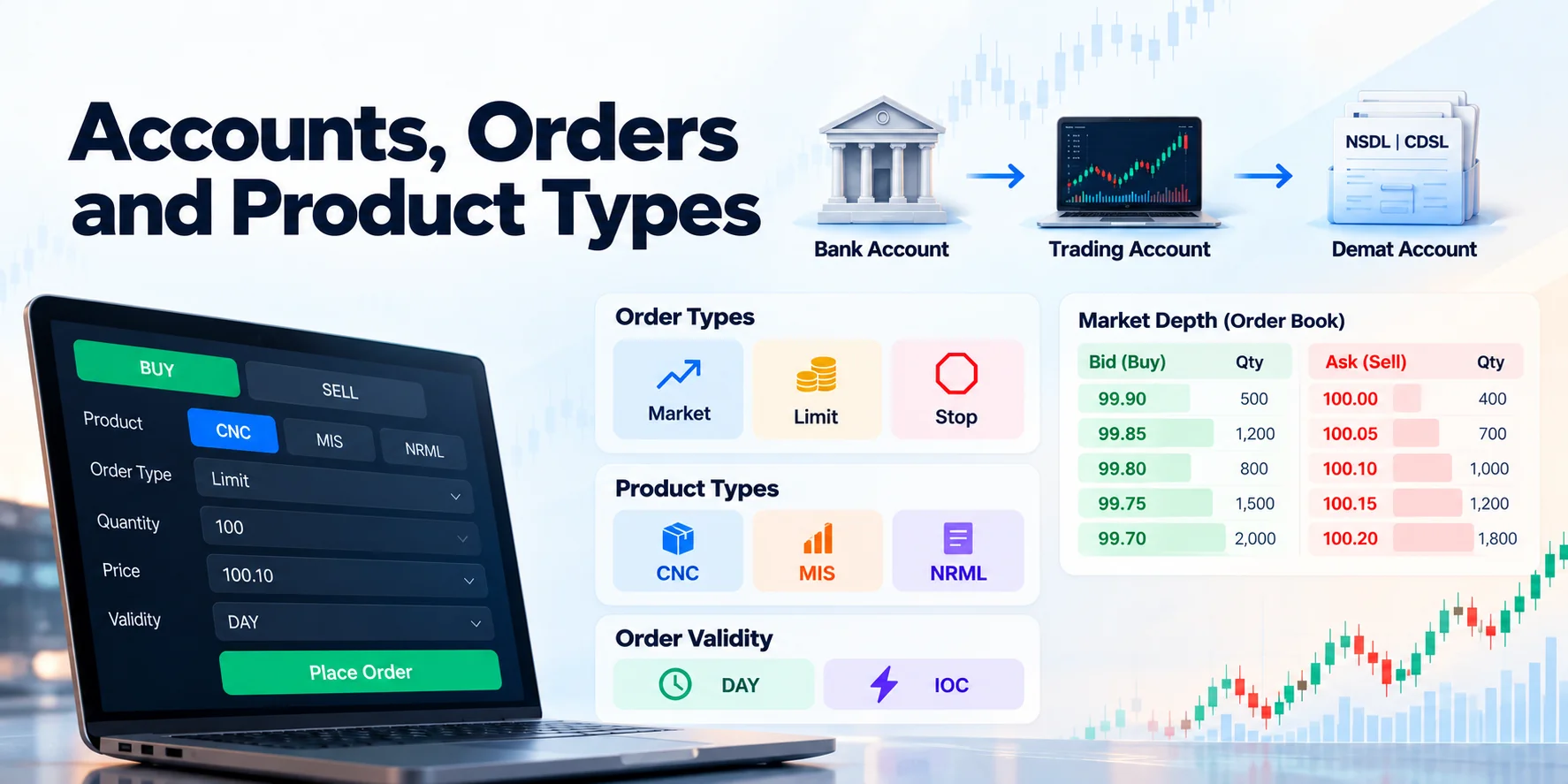
Margin Trading Facility financing is a separate thing again: the broker finances part of an eligible purchase, you pay margin and interest, and the broker may take a pledge. See accounts, orders and product types for how MTF differs from an intraday position.
Worked example: equity delivery
Hypothetical, on NSE, using the rates in force on 14 October 2026. The brokerage assumption is declared: ₹20 per executed order, two orders. Many brokers charge nil on delivery, which would remove that line only.
Buy 200 shares at ₹500, sell at ₹550.
| Amount | |
|---|---|
| Buy value | ₹1,00,000 |
| Sell value | ₹1,10,000 |
| Gross profit | ₹10,000 |
| Charge | Basis | Amount |
|---|---|---|
| Brokerage | 2 orders × ₹20 (declared assumption) | ₹40.00 |
| STT | 0.10% on buy and sell: ₹100 + ₹110 | ₹210.00 |
| Exchange transaction charge | 0.00307% on ₹2,10,000 turnover | ₹6.45 |
| SEBI turnover fee | 0.0001% on ₹2,10,000 | ₹0.21 |
| IPFT contribution | ₹0.01 per crore each side | ₹0.00 |
| Stamp duty | 0.015% on the ₹1,00,000 buy | ₹15.00 |
| GST | 18% of (₹40 + ₹6.45 + ₹0.21) | ₹8.40 |
| Total charges | ₹280.06 | |
| Net trading P&L | ₹10,000 − ₹280.06 | ₹9,719.94 |
STT is 75% of every charge in this trade. Exchange, SEBI and IPFT together come to under ₹7, and brokerage to ₹40. If you were looking to cut costs on delivery trading, STT is the only line with real size, and it is not negotiable.
A DP debit charge may also apply to the delivery sale. Its rate varies by broker and by the number of ISINs, so it is excluded from the arithmetic above and should be read off your own contract note.
Worked example: equity intraday
Same declared brokerage. Buy 100 shares at ₹1,000, sell at ₹1,010.
| Amount | |
|---|---|
| Buy value | ₹1,00,000 |
| Sell value | ₹1,01,000 |
| Gross profit | ₹1,000 |
| Charge | Basis | Amount |
|---|---|---|
| Brokerage | 2 orders × ₹20 (declared assumption) | ₹40.00 |
| STT | 0.025% on the sell only | ₹25.25 |
| Exchange transaction charge | 0.00307% on ₹2,01,000 turnover | ₹6.17 |
| SEBI turnover fee | 0.0001% on ₹2,01,000 | ₹0.20 |
| Stamp duty | 0.003% on the ₹1,00,000 buy | ₹3.00 |
| GST | 18% of (₹40 + ₹6.17 + ₹0.20) | ₹8.35 |
| Total charges | ₹82.97 | |
| Net trading P&L | ₹1,000 − ₹82.97 | ₹917.03 |
DP delivery-debit charges generally do not arise here, because nothing is delivered. A fully intraday, non-delivery equity transaction creates no delivery obligation, and so no debits to charge for.
The same trade under delivery terms would carry STT on both sides and 0.015% stamp duty, which is a materially different bill for an identical gross profit.
Worked examples: futures and options
Futures. Sell 75 units at ₹24,000, a traded value of ₹18,00,000.
- STT at 0.05% = ₹900.00
- STT at the previous 0.02% = ₹360.00
- The 1 April 2026 change added ₹540 per sell-side trade of that size, a 150% increase
Options sold. A call sold at a ₹100 premium, lot size 75.
- Premium turnover = 75 × ₹100 = ₹7,500
- STT at 0.15% = ₹11.25
- Exchange transaction charge at 0.0355299% of premium turnover = ₹2.66
That last line is the distinction worth keeping: the exchange fee is computed on the ₹7,500 premium, not on the underlying’s notional, which for an index option would be many times larger.
Remember the bases are different objects: contract notional, premium turnover, intrinsic value and gross P&L are four different numbers, and each charge attaches to one of them rather than to “the trade”.
Do not generalise these equity derivative rates to commodity or currency contracts, which have their own STT, CTT and charge schedules.
Two meanings of turnover
This is the most commonly misunderstood term in the chapter, and the two meanings are genuinely different calculations.
A. Traded value, used for charges
The transaction values on which exchange charges, STT, stamp duty and similar levies are calculated. The base depends on the levy and the product, which is why options use premium turnover.
Suppose a trader buys one futures contract at ₹10,00,000 and later sells it for ₹10,10,000.
| Measure | Value |
|---|---|
| Purchase transaction value | ₹10,00,000 |
| Sale transaction value | ₹10,10,000 |
| Combined traded value | ₹20,10,000 |
| Profit | ₹10,000 |
Not every charge applies to both sides or to that combined amount. Stamp duty is buy-side, intraday STT is sell-side, and the total you actually pay is the sum of the correct individual lines, not a rate times the turnover.
B. F&O tax turnover, used for income tax
Income-tax accounting uses a different concept, in which the absolute values of favourable and unfavourable transaction differences form an important part of the calculation.
| Measure | Value |
|---|---|
| Profitable transaction differences | ₹40,000 |
| Loss-making transaction differences | −₹25,000 |
| Absolute total | ₹65,000 |
The treatment of option premiums and other special cases requires care, and it follows the ICAI guidance on tax audit rather than a single universal formula. The example above does not necessarily capture every adjustment a real options tax turnover needs.
Two things to avoid. Do not treat turnover alone as creating a tax-audit obligation: audit applicability also depends on statutory thresholds, the nature of the income and other conditions. And do not present one turnover number as the answer to both questions above. The detail is in taxation.
Cost drag and break-even
Net profit   = Gross profit − Total applicable transaction costs
Break-even gross profit = Total applicable transaction costs
With charges of ₹120 on a trade:
- Gross profit of ₹500 gives a net of ₹380.
- Gross profit of ₹80 gives a net of −₹40, a loss.
The same ₹120 of cost behaves very differently depending on the size of the edge. This is why costs can be decisive for short-duration, high-frequency and small-target strategies, and much less decisive for a lower-frequency approach with a wider target. It does not mean cost impact is identical for every strategy, and it does not mean frequent trading is unprofitable in every case. It means the ratio of cost to gross edge per trade is the number worth calculating before you run a strategy at all.
The contract note
The contract note is your broker’s formal record of trades and the charges on them. It is where execution-related costs can actually be verified.
It typically records the trade date, client and broker identifiers, exchange and segment, security or contract description, buy or sell quantity, execution price, order and trade identifiers, time of execution, brokerage and statutory charges, and other required disclosures.
Several related records exist and they are not the same document:
- Contract note. Trades and charges.
- Trade book. Individual fills against your orders.
- Order book. Every order with its status, including unfilled ones.
- Funds ledger. Cash movements, deposits, withdrawals and charges.
- Demat holding statement. What you actually hold.
- Exchange trade confirmation. The exchange’s own record.
A trade executed today can appear on the contract note before the securities settle into your demat, because settlement runs on a later cycle. So a temporary mismatch between today’s contract note and today’s demat holdings is not, by itself, evidence of wrongdoing. That is a timing difference, not a discrepancy.
To check properly, compare your broker’s records against the exchange’s trade data and the depositary’s holding statement, since those are independent of your broker’s app. If something does not reconcile, the escalation path is your broker’s grievance process, then the exchange’s investor grievance mechanism, then SEBI’s SCORES portal. See SEBI and investor protection.
The contract note is the authoritative starting point for execution-related charges. It is not a guarantee against loss or fraud, and taxation or accounting may require additional records beyond it.
Running account settlement
Excess client funds held with a trading member are returned to the client under SEBI’s framework, on a cycle the client elects.
- Clients may elect monthly or quarterly settlement. Quarterly is not the only permitted cycle.
- Exchanges publish the settlement calendar.
- Brokers may retain permitted amounts against outstanding obligations and other specified purposes.
- Under SEBI’s January 2025 measure, a qualifying client who has not traded for 30 calendar days, with qualifying funds still held, has the credit balance settled on the upcoming monthly running-account settlement date, subject to the circular’s conditions.
- If the client resumes trading before that date, the normal elected monthly or quarterly cycle applies.
So the accurate statement is not that funds are credited to the bank the moment the thirtieth inactive day passes. It is that an upcoming scheduled settlement date applies.
This is also a different process from a voluntary withdrawal request, from exchange trade settlement, from quarterly settlement of securities, and from bank transfer processing. They can happen on different timelines.
Before you trade, check
- Your broker’s brokerage tariff, and whether it is per order or per trade.
- The exchange and segment, since rates differ.
- STT or CTT treatment, and which side it falls on.
- Exchange transaction charges, and for options whether the base is premium.
- SEBI turnover fees, and the debt-securities rate if that is what you are trading.
- GST, and the base your broker actually uses.
- Applicable stamp duty, on the correct side.
- DP or pledge service fees, and whether per-ISIN.
- Financing interest, if you are using margin or MTF.
- Delivery or expiry obligations that could create costs beyond the trade.
- Your estimated break-even after charges, not before.
- The actual contract note and a funds ledger reconciliation after the fact.
The contract note is where actual execution charges get verified. Tax and accounting records are a separate requirement and may need more.
Next: SEBI and investor protection.